The conversation
Designing the Future: Dr. Feby Abraham on Healthcare Innovation
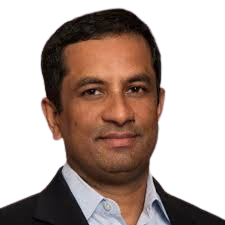
Memorial Hermann Health System Executive Vice President Dr. Feby Abraham discusses his journey from an Indian Air Force upbringing to leading corporate strategy and digital transformation at one of Houston’s largest healthcare networks. He details the implementation of ambient AI to automate clinical documentation, the strategic shift toward hospital-at-home models, and why the next major horizon in medical innovation lies in proactive, data-driven disease prevention.
6Degrees
Dr. Feby Abraham has built a career at the intersection of healthcare, strategy, and innovation, redefining how hospitals improve patient access and integrate technology. As the Executive Vice President and Chief Strategy & Innovations Officer at Memorial Hermann Health System, he plays a key role in shaping the system’s future by making healthcare more accessible and efficient.
Born in India, Dr. Abraham spent much of his childhood moving due to his father’s career in the Indian Air Force.
Dr. Feby Abraham
I did my schooling in different parts of India, from south to north, east to west.
6Degrees
Growing up around fighter jets and aerodynamics, he developed a fascination with airplanes, fast cars, and mathematics, which fueled his decision to pursue mechanical engineering. He later earned a Ph.D. in mechanical engineering and applied mathematics from Rice University, focusing on computational modeling and AI-driven solutions.
Though he began his career in engineering and AI-driven research, Dr. Abraham found himself drawn to business strategy and decision-making. His time at GlaxoSmithKline (GSK) exposed him to high-level strategy discussions on drug development, investment priorities, and company acquisitions.
Dr. Feby Abraham
I saw myself at the cusp of providing insights into a lot of those questions. But I was fascinated by those questions, and I said, well, I'd love to be in a career that helps shape the solution to some of those bigger problems.
6Degrees
His desire to drive strategic decision-making led him to McKinsey & Company, where he spent nearly 12 years advising healthcare companies, private equity firms, and Fortune 500 organizations. In 2020, he transitioned to Memorial Hermann, where he now leads the system’s corporate strategy, digital transformation, and innovation initiatives.
A major focus of his work has been expanding patient access and ensuring people can get care when and where they need it.
Dr. Feby Abraham
One of the core things that we're trying to do is think about sending the right patient to the right site of care.
6Degrees
Under his leadership, Memorial Hermann has expanded virtual care services, partnered with Zocdoc for same-day doctor appointments, and launched over 30 urgent care clinics across Houston.
Dr. Abraham has also been instrumental in Memorial Hermann’s adoption of AI-driven tools.
Dr. Feby Abraham
We now have a tool that allows doctors to have conversations with patients without having to manually enter everything into a computer.
6Degrees
AI listens to doctor-patient interactions and automatically generates structured notes, significantly reducing administrative work. His team has also invested in precision medicine and hospital-at-home models, using data analytics to personalize treatments and reduce unnecessary hospital visits.
Despite the success of these innovations, challenges remain.
Dr. Feby Abraham
Whenever you introduce new technology, you have to ensure buy-in from doctors, nurses, and staff. You also have to make sure it actually enhances patient care and creates financial value.
6Degrees
Looking ahead, Dr. Abraham envisions a future where healthcare is proactive rather than reactive.
Dr. Feby Abraham
The next wave of innovation will be about preventing disease before it happens.
6Degrees
For young professionals, his advice is simple: dream big, learn from every experience, take care of yourself, and enjoy the journey. His leadership at Memorial Hermann continues to push the boundaries of healthcare innovation, ensuring that technology, data, and patient needs remain at the forefront of modern medicine.